I recently spent a little time doing maintenance work on my Facebook account. Apparently Facebook still knows that I like riding a bike.1 Apparently Facebook also still knows that I have a certain affinity for Hamburg. So my feed served me a whole series of articles about crashes in the Vier- und Marschlande, the rural districts on Hamburg’s eastern edge. And in particular about crashes on one single road.2
The road in question runs along the Elbe dyke on the northern bank. The route is genuinely lovely. I rode it often back when I was seriously into road cycling. The problem was that I first had to ride 25 km out from Lüneburg and 25 km back. Back then I seriously considered moving to the area. Maybe I still will one day.3 Because the whole Marschlande and Vierlande region is a wonderful place to ride. Picture it like this: parts of it look like the deepest reaches of East Frisia. Flat. A gloriously wide view. My fondness for that sort of landscape is probably built into my genes. The highest point is the dyke. And yet you’re in central Hamburg in maybe 20 minutes. This is Hamburg city territory. One moment flat open country, the next you’re at the IKEA in Moorfleet.
Except there’s a very odd crash pattern there. With striking regularity, road cyclists crash by riding into a vehicle in “stationary traffic” and injure themselves, sometimes seriously. For some reason these cyclists simply slam into the back of parked cars. On some weekends it happens more than once. In 2025 alone there were 26 crashes of this kind, according to the ADFC, Germany’s national cyclists’ association.4 And there have been several more this year, as you can read at the public broadcaster NDR, for example here and here.
Now, Facebook hosts a number of pseudo-news channels that write about this in the style of outrage inflation that has sadly become standard on the internet. “When will this madness end”, or words to that effect. Ragebait and clickbait headlines are presumably just standard tooling for the writing trade these days, a way of getting any attention at all. Tribute to the modern attention economy, in which everyone is trying to generate engagement somehow. Sigh.
What’s genuinely catastrophic, though, is the culture of debate that shows its face beneath articles like these.
The Hamburg ADFC’s proposal to introduce a “no-stopping zone along the Elbe dyke” quickly turned, in the discussion, into the claim that the ADFC was demanding — or would soon demand — a “driving ban for cars”. That was not what the ADFC wanted at all. Even so, the proposal acted like an accelerant on this debate. I’d like to link to two ADFC statements here: first Unfälle am Deich: Wenn Appelle nichts bringen, müssen Politik & Polizei handeln, and second Stellungnahme zur Pressemitteilung Unfälle am Deich. The proposals have, however, already been rejected by the city’s interior authority.5
There are a few things I’d like to explain here.
What makes this spot unusual
To understand what’s happening there, you need to know one peculiarity of the road. If you want to go for a walk along the Elbe, you pull over to the edge and leave the car there. Which means the car is, first and foremost, standing on the road. The road isn’t very wide, but calling it a several-kilometre-long pinch point would be an exaggeration too. Two cars can pass each other perfectly comfortably, without breaking so much as a sweat.6
There isn’t really anywhere else for the parked cars to go, either. On one side there’s a footpath in places, but often just the inland face of the dyke. On the other side the ground drops away surprisingly far down the dyke. Staying on the road makes sense. Including for parking.
What makes it stranger still: the area looks as though it were just outside the city gates. You know you’re close to the city. But it doesn’t look as though you’re already inside the city of Hamburg. The road looks like a rural road outside any built-up area. And on a priority road outside a built-up area, I’m not allowed to park. This would be correct. Except: this road lies beyond the Hamburg town sign. Which legally makes it a “built-up area”. Past this sign I can carry on along these dyke roads for nearly 29 km without anything remotely resembling a town. Legally, I’m still “within a built-up area”. And that means I’m allowed to park on the road.7
And this is where the conflict comes from.
To illustrate: it looks roughly like this image (Google Street View) — a car parked at the edge of the road. Somewhere nearby is usually the driver, plus companions and possibly a dog. Because the area really is lovely for dogs too.8 Sometimes the car is parked exemplarily, right at the edge as in the picture; sometimes it sits a bit further out into the road. It doesn’t really matter, though: under no circumstances is the road wide enough for two cars to pass each other alongside a parked one.
So how does the problem actually arise?
There are a number of hypotheses about this. Two of them strike me as realistic.
The first — and simpler — hypothesis is that people ride with their heads down, as aerodynamically as possible, staring at their bike computer, and in doing so fail to notice that there’s a car standing there. And I believe that instantly. I’ve watched people walk into lampposts with a phone in their hand. “Woooo — 600 watts on that effort”, and a short while later the ambulance or the helicopter arrives. Much to the justified exasperation of the locals, who come running to give first aid while thinking: “Not again?”9 It is a problem. Which is why I think campaigns like the Hamburg police’s “Kopf Hoch” — “heads up” — are both sensible and necessary.
The second hypothesis is a bit more involved. It’s essentially an extension of the first, and it may go some way to explaining why the head stays down. People know perfectly well that you’re supposed to look ahead. So why don’t they? The world comes at us relentlessly. Through every one of our senses. For our conscious mind to cope with it, what arrives there is a pre-processed version. That’s how optical illusions work. As I wrote, walkers’ cars are parked in the middle of the road. The hypothesis is now that the brain sees a car in the middle of the road and frequently sends the message “there’s a car driving on my side of the road” up to conscious thought. Since cars are usually faster, and since you have the rear end of one on your own side of the road ahead of you, the brain sees no danger — and in ordinary city traffic that’s perfectly correct. As far as your mind is concerned, the car is moving away from you. It’s just that parking on this particular road isn’t ordinary city traffic.
The brain suppresses the danger, and the next time the brain gets around to the matter and notices “oh, shit, that car is getting bigger”, it’s very much the last minute — and depending on your speed it can be too late to react. I can picture that too.
On top of that, when you ride a road bike you’re often down in the drops, bent forward. Your gaze isn’t permanently directed ahead; a good deal of the time it’s directed downwards. In itself that’s not a problem. But: when I ride a Dutch roadster, my gaze is fixed ahead the entire time. I get many opportunities to notice that the car is stationary. Now let’s say I only look ahead every 5 seconds. That would be an extreme example. When I’m in the drops I run a sort of adaptive model …. if I see hazards, I look ahead constantly … neck muscles be damned. And from conversations with other racing cyclists I know they handle it much the same way.
The reasoning is understandable, too. If, as far as I can see, there’s no danger, then it’s not a wholly unreasonable assumption that at bicycle speeds nothing will change about that in the next 5 seconds. Besides, as a cyclist you have to keep an eye on the road surface anyway …. a pothole that a car’s suspension simply swallows can put a bike on the ground. And then there’s the whole business of broken glass, small debris and the like. In practice I was constantly alternating between scanning the road “far ahead” and “just in front of me”.10
If I see a car at the roadside 1 minute in advance (the area really is flat), then I get 12 opportunities to break through this misperception. At 30 km/h, that’s 500 metres away. That’s a long way off. No danger. Your mind initially ignores it. It’s also hard to tell whether the car is moving or stationary.
But with every second I get 8 metres closer to the car. 40 metres between glances. Realistically, I’d say it registers as a possible hazard around 20 seconds beforehand. That leaves 4 glances before the parked car’s tailgate, assuming you’re not using an adaptive glance frequency. 160 metres. The speed differential isn’t high, either. The limit for cars there is 50. So the car is only pulling away at 20 km/h. A well-trained cyclist with a bit of a push from the wind can comfortably hit 40 km/h there. A 10 km/h difference.
I think it’s very plausible that a misperception occurs here: that the car is moving when in reality it is standing still. The mind doesn’t switch to danger mode, the glance frequency isn’t adjusted. The “danger” trigger is missing. Or it simply never reaches conscious thought. Not deliberately. Not because the person doesn’t know better. For whatever reason, the trigger gets filtered out.
Each glance is only brief. Just long enough to confirm the existing mental model “there’s a car driving”, but nowhere near long enough to break that model and replace it with “THERE IS A CAR STANDING THERE!!!”. On a Dutch roadster you stare straight ahead essentially all the time, and the model has time to develop at leisure; what matters isn’t so much looking more often as looking for longer.
It has to be said, though, that those 4 glances are almost always entirely sufficient. But sometimes they aren’t. And then it ends up in the paper.
A universal problem
Incidentally, the problem isn’t easy to solve technically either. When I first read about it, my instinctive thought was “well, there are radar tail lights that warn me about cars coming up behind me. Something like that pointing forwards would be handy”. Think about it for a second longer, though, and it becomes clear that a radar tail light for detecting vehicles approaching dangerously from behind and a front light for detecting an imminent impact into the rear window of a stationary vehicle are two entirely different problems.
A radar tail light has a fairly simple job. There are objects in the radar signal that move relative to me, and objects that stay put relative to me. To begin with I can filter out everything that moves away behind me at exactly the same speed at which I’m moving forward. Those objects are obviously standing still. That single step filters out the entire static world around me. Among the remaining signals, I filter out whatever is moving away from me faster than I’m moving forward. Those vehicles are obviously travelling in the opposite direction and are already behind me, so they’re no danger. Anything that appears not to move in the signal is travelling at the same speed as me: no immediate danger, but worth noting. What’s left are vehicles moving towards me, and those represent a hazard.
Detecting a stationary car on the road ahead of me is an entirely different problem. It approaches me exactly like the rest of the environment (a lamppost, say), at exactly the speed I’m riding. The mechanism above would simply filter the stationary car out. And not filtering isn’t an option either, because there are a great many stationary objects around me. A light like that would have to decide which object is dangerous and which isn’t. It would have to decide from context — for example: is the object on the road or beside it? This is certainly solvable; automatic emergency braking systems are proof of that.
And even those had, and still have, their problems. At the moment I can only drive up my own driveway at 2 km/h. My emergency braking assistant triggers reproducibly at one particular spot, and no amount of hedge trimming has fixed it. These days I let passengers get out beforehand, because the full-force braking is pretty violent. Solving this problem technically, within a sensible budget for cost, weight and power consumption, and with a low false-positive rate, for a bicycle — that is likely to be enormously difficult.
At the same time, the mere existence of the emergency braking assistant shows that statements like “the road cyclists should just pay more attention, then nothing would happen!” are far too simple an answer to a complex problem. With perfect attention and consistently correct assessment of the situation, there would be no need for emergency braking assistants. The fact that they exist anyway — and have been mandatory on new cars since 2024 — tells me that we have to deal with mistakes and accept that they happen.
And if electronics with their unbroken attention and precise sensors already struggle to solve this problem, then a human being, with all their sensory perceptions and misperceptions, has a considerably harder time avoiding this situation. And even the electronics, for all that they may have everything permanently in view, are not infallible.
What humans and technology have in common is that all of these solutions rest on filtering the world in order to understand it and ultimately react to it. Filter correctly and nothing happens. Filter out something important at the wrong moment and, well, crashes happen. Humans and technology both need these filters, and calibrating them is the biggest problem. Filter out too little and I never get across the junction, and my car slams on the brakes at the hedge; filter out too much and I miss something. The stationary car. Or the pedestrian crossing the road.
You may be thinking: “yes, but I ride past goodness knows how many cars parked on the road every single day”, and that’s certainly true. But in a residential street you expect it; the filter is calibrated differently. Considerably more finely, because at any moment you’re expecting a child to run out from between the cars. On a dyke road where two cars can pass each other without difficulty when nothing is parked at the edge, and where no housing is in sight, you don’t expect it. The mental filter is set to middle-of-nowhere-country-road mode. And this is within a built-up area — remember?
And on the other side of the ledger, cars run into the back of traffic jams, there are rear-end collisions in queues, wing mirrors get taken off parked cars. It works most of the time, but not always. That’s no different for a road cyclist than it is for a driver.
Road cyclists aren’t monsters
I’ve now spent quite a while on why I think this problem arises, and on why it’s an inevitable feature of human beings and their fallibility, regardless of how those human beings get around.
What really bothers me, though, is the culture of the debate. I sometimes get the impression from these discussions that the non-road-cycling population regards us as narcissistic egomaniacs who show consideration for nothing and wouldn’t care if they hit a child.11 I can say this much: there are certainly narcissistic egomaniacs among us. At roughly the same rate as in the general population.
But: even if you assume that road cyclists are selfish narcissists, no road cyclist enjoys crashing. Out of pure self-interest. Because it hurts. Hurts a great deal. Because with bad luck it keeps you off the bike for weeks or months. Road surface festers very badly once you’ve dragged chippings into your skin. Been there. Done that.
I don’t know why it’s road cyclists in particular who have been cast as the Blofeld of this debate. Is the MAMIL12 or MAWIL, presenting drivers with a more or less well-formed13 Lycra-clad backside on a saddle, some sort of extended middle finger to other road users? I genuinely don’t know.
Or is a small group of egomaniac road-cycling idiots ruining it for the rest of us? A group I simply haven’t run into at that level of intensity yet? But for which I’m nonetheless held collectively liable?
Bile and venom
And it really is bile and venom that surfaces in these comment sections. Hated and spat upon. Nothing short of banning road cyclists from public roads will do. “It’s a sport!” …. “They should go and ride round in circles on a closed circuit” … “The lot of them are idiots.” … “Some a****** nearly ran me over the other day” … “Who do these road cyclists think they are, riding around in their romper suits like Jan Ullrich14”
But you’re not allowed to do sport on the road, are you?
This is a much-loved argument in these discussions. Road bikes are sports equipment. They’re not even road legal. You’re not allowed to do sport on the road. Out comes § 31 of the German road traffic regulations (StVO)! Ha. Checkmate. Off the road with you! Er. No. As always, the world is a bit more complicated than that. The paragraph does indeed exist: “Sport and play on the carriageway, the hard shoulder and on cycle paths are not permitted.” There’s just one problem with it: road cycling is not sport within the meaning of § 31 StVO. Nor, from the point of view of the vehicle construction regulations (StVZO), is a road bike a piece of sports equipment like a ball or a skipping rope. What helps here is § 63a StVZO: “A bicycle is a vehicle….”. A road bike is a bicycle, therefore a road bike is a vehicle. And using a vehicle isn’t sport, it’s transport.
The point of § 31 is that on streets not explicitly designated for it (Germany’s “play streets”), people shouldn’t be playing football or, for that matter, skipping rope. And even that isn’t clear-cut: in East Frisia people play Boßeln — a traditional ball-throwing game — on public roads, and the police don’t immediately put a stop to it. Un nu?15
A public road dedicated to general use by all vehicles (and the road along the Elbe dyke is unquestionably such a road) may be used by vehicles without restriction and as intended, for the purpose of getting from place to place. A road can also be dedicated in a way that does not serve general use — a motorway, for instance. I’m not allowed to take my bike onto one. And nobody wants to ride the A1 on a bike anyway. Or, as another example, the cycle path: I’m not allowed to take my car onto one, even if I do occasionally notice that drivers aren’t especially bothered about this, provided there’s no barrier present that would damage the car sufficiently (there, it seems, inhibitions do exist).
My road bike is a bicycle, is a vehicle on a public road, and I am obviously using it to get from place to place. That means I am using the road as intended and have a right to use it — subject to the duties of a road user, and with the rights of a road user.
What matters here is that I am travelling. If I take up one-armed steel-bike lifting on the road, that obviously isn’t covered, because it isn’t travel — even though the object being lifted is unquestionably a vehicle.
That the travelling also serves to keep me fit is a motive for travelling, but the law doesn’t ask about motives. We are, thank whoever, not living in a state where I’d have to explain why I’m travelling from A to B — even if A and B may happen to be the same place.
If a police officer stopped me while cycling or driving and asked why I was going to B, I’d certainly reply that it was none of their business. But forbidding someone to travel without a reason would amount to my having to tell the officer where I’m going (truthfully or otherwise) in order to avoid falling under suspicion of travelling without a destination. At that point we’re well beyond the limits of my understanding of fundamental rights (see Article 2(1) of the German constitution). Such a regulation would therefore be unenforceable. And an unenforceable regulation is one I can do without.
If you followed the “road bike = sport = not allowed” line of argument, I also wouldn’t be permitted to go for a walk on the pavement, since walking serves to keep me fit rather than to reach a destination — and certainly not from the moment you step onto a road to cross it, because at that point you’ve moved from the pavement (where it is allowed) onto the road (where, on this reading, it wouldn’t be, since it constitutes sport). A ride through the undeniably beautiful Vierlande on a touring e-bike would be equally impermissible, since it doesn’t serve to reach a destination but rather one’s personal enjoyment of the beauties of this part of Hamburg.
Although … careful! Road cycling in a large bunch (and by that I mean high double figures and into three) is a sporting event, and that in turn requires a permit if it takes place on public roads. But the crashes didn’t happen in bunches like that. And that’s not the kind of event I’m talking about. These were solo riders or very small groups.
And the perennially loathed riding two abreast? Perfectly legal. Because § 2(4), second sentence, StVO states: “Cycling two abreast is permitted provided that traffic is not thereby obstructed; otherwise cyclists must ride in single file.”
“Obstructed” here doesn’t mean “existing within the same space-time continuum as me on the road” or “I had to brake”, but rather, for instance, “they can’t be overtaken because the road is too narrow”. And § 2716 of the same regulations provides that more than 15 cyclists (so 16 and up) may form a closed group. For such a group the obstruction restriction no longer applies. Riding two abreast then no longer hinges on the obstruction question; the group counts as a single vehicle. Rather like a funeral procession.
There is, incidentally, a good reason for riding two abreast. It’s neither defiance nor “I don’t care”. It reliably prevents drivers squeezing past when two cars meet. Which makes it potentially safer for the cyclists.
And the argument that “those road bikes aren’t even approved for the road”? One could get pedantic and reply: why would they be — there is no type approval for bicycles. But I do know what people are getting at. It’s the equipment requirements of the StVZO: a bell, two independent brakes, lighting and reflectors. I’m quite sure that reflectors, at least, are often missing from road bikes. The point is: their absence doesn’t turn the road bike into a piece of sports equipment. It remains a vehicle that is missing prescribed safety equipment. That may earn you a regulatory fine, but it doesn’t cost you any rights.
And now, seriously: let’s assume the bike has nothing at all except a set of brakes. If a parked car could be impressed by a bell, then the vehicle would vanish the moment reflectors … er … reflected. None of this has anything to do with the crash pattern in the Vierlande.
Ban everything
I take a particularly dim view of calls for bans. Road cyclists have exactly the same right as every other road user to use this road, including at the speed they choose. As long as — and this is the important qualification — they comply with § 1 StVO. The same applies to drivers. Anyone who wants to ban some other group from something should be clear about how slippery that slope can get.
The way I see it, laws don’t exist to blindly forbid one group something in order to make life easy for another group, or to rid the world of things one group dislikes. They exist to order how we live alongside one another. And if we’re going to introduce rules over and above the ones we already have, the yardstick shouldn’t be prohibition but rather the question: is there a way that makes both sides happy? Compromise. Something both sides can live with. Neither a pure motor road nor a vastly oversized cycle path. Something in between. But some people love living inside a cocoon of their own rights, so long as the bans only affect other people. That’s something I sadly encounter very often in the comment sections of social networks, on the rare occasions I use them.
Double standards
What irritates me a little about these discussions is the unequal yardstick applied to the situation. And that’s perhaps the first thing we need to take off the table here. There’s a frequent accusation that cyclists ride far too fast, that they’re inattentive, and that they get abusive when you point out their mistakes. The question that occurs to me is: and how exactly does that differ from present-day road traffic on foot or by car?
This isn’t meant to become a tu quoque … an ad hominem played off the cushion, as it were. Road cyclists aren’t blameless just because others do it too. Missing an entire car may be explicable, but it remains an unnecessary crash. Still, all road users ought to take a look at themselves and ask whether there isn’t a shared root cause behind these crashes in general.
Shortly before I got involved in one of these Facebook discussions, Hamburg held its Speedweek: blanket speed enforcement. In one week there were 4,000 speeding offences in Hamburg. Ah yes. Road cyclists ride far too fast. Okay. That’s one way of looking at it.
The police publish crash statistics for Hamburg: https://www.polizei.hamburg/resource/blob/1148740/8e2d9dd3f040948c76ffcdfd72434d45/vksb-handout-do-data.pdf. I have to make a few assumptions here, and this is possibly where things get shaky. Rear-end collisions are the classic inattention crash. As far as I know they sit in the statistics under “speed and following distance”. Through inattention, someone fails to keep a safe distance. Doesn’t look at the road. Doesn’t see the car in front stopping. To get a sense of what happens on Hamburg’s roads every single day: 64,310 crashes a year. 176 crashes reported to the police every day. Car park scrapes settled by exchanging contact details, without any blue-and-white assistance, aren’t even included in that. 15 % of reported crashes fall into that “speed and following distance” category. That, too, is a great many. 9,646 crashes. 26 a day. I’d like to venture the claim that a good number of those drivers weren’t looking at their bike computer but simply at their mobile phone. Ah yes. So road cyclists ride inattentively. Okay. That’s one way of looking at it.
And as for how often I’ve been given the one-finger salute and other unfriendly expressions of displeasure by drivers while riding on a road I was definitely entitled to ride on (and where there was nowhere else to ride) … I think the count is in double figures. Early on I used to get worked up about it. These days I accept it as mobility normality. Only yesterday, out walking the dog, I watched a driver hurling abuse at someone for not pulling far enough forward while turning.17 Ah yes. So road cyclists are the ones being abusive. Okay. That’s one way of looking at it.
What I’m driving at — and here I come to the shared component, the root cause — is this: I see a growing loss, across every category of road use, of the ability to behave as partners rather than opponents. There seems to be only one reason why the criticism concentrates on road cyclists. And that’s the real question: why is it so conspicuous with road cyclists, why are they singled out for criticism, why is it their hobby in particular that people want to restrict with bans, when the same phenomena are to be found everywhere? At which point, in my view, we arrive at a distortion of perception.
Then again, it’s likewise only a subgroup of drivers who genuinely drive in a way that endangers cyclists, where dangerous situations no longer come across as mistakes. I see a great many drivers who pass me with plenty of room. I see a great many drivers who give way to me as a cyclist where I’m entitled to it, and who don’t simply fail to see me. The enemy image that cyclists hold of drivers misses the point just as badly, in my view. They’re only people making mistakes too.
The wicked, wicked road cyclist
So why does the anger discharge itself onto road cyclists? I think a kind of enemy image has built up here. It isn’t even about all cyclists. If someone rolls past on their Riese & Müller sofa-on-wheels,18 that seems to be fine somehow. No, this enemy image is purely about road cyclists, and perhaps mountain bikers as well. In these discussions you often hear “a road cyclist nearly mowed me down the other day” or “I saw a road cyclist ride straight through a crash scene”.
First of all: I don’t dispute that there are genuine idiots among road cyclists. In fact I’m quite certain there are, because there are in every group. Beyond that, I subscribe to the “everyone is an idiot — for a brief moment” hypothesis. If everyone behaves like an idiot in traffic for 5 minutes a year (inattention, being in a hurry, whatever), then with 80 million people in Germany and almost as many road users,19 the probability is very high that at any given moment of my own time in traffic there’s an idiot somewhere near me. And if I can’t spot the idiot, I should think very hard about whether I’m currently having my own 5 idiot-minutes.
I also think the whole story is rarely told. “A road cyclist nearly mowed me down.” As I wrote, road cyclists are acutely aware of their own vulnerability. They don’t want to mow anyone down deliberately.
Nobody crashes for fun.20 So the question is what’s missing from the story. What I’ve observed, for instance: other road users simply stepping into the road while you’re coming down it on a road bike, leaving you nothing to do but swear and try to salvage the situation. A touring cyclist with motor assistance turning off without any hand signal while you were about to continue straight ahead. A driver failing to see you entirely, leaving you to find the narrow escape route between “swear and ride on” and “lie in the road groaning”.
I think that in stories like these, one’s own misbehaviour is consistently a not insignificant contributing factor. Why? Because attentive behaviour by one person often compensates for inattentive behaviour by another. As a cyclist, as a driver and as a pedestrian, I assume other people are being inattentive, and behave accordingly. And I equally hope that the people around me are applying the same attention, so that I too can make the occasional mistake — which is ultimately inevitable. As a cyclist I reckon with someone simply flinging a car door open without looking. As a driver I reckon with someone simply stepping into the road when people are standing close to the kerb. Just as, when I’m on foot, I assume a cyclist may not have seen me.
It’s difficult to find clear-cut blame when a road cyclist nearly hits you but you also stepped into the road. It’s difficult to find clear-cut responsibility when you nearly ride into another cyclist but that cyclist crossed your line while overtaking without signalling.
So I often think that in hairy situations one’s own inattention is a contributing cause. A road cyclist may well ride past a pedestrian swearing horribly. But mostly they aren’t doing that because they’ve organised an abuse parade through the Vierlande — they’re doing it because another cyclist couldn’t hold their line, or a pedestrian wandered across the path without looking. All of it things I’ve seen myself. And, to my shame, done myself. I too have shouted after a cyclist about what I thought of their steering skills. And informed a pedestrian that he had tomatoes growing on his eyes.21
I do rather struggle to understand the hatred that surfaces in these forums. The person suffering physically is chiefly the cyclist himself; everything else is property damage, covered by the cyclist’s liability insurance. Yes, as a resident you can be legitimately annoyed. But this hatred?
If that strikes you as too favourable to road cyclists, let me ask you for a thought experiment. Close your eyes. Picture yourself sitting in a car, about to reverse out of a parking space. It’s Saturday morning. Any supermarket car park in Germany. Or the car park of a DIY store, if you prefer. Same challenge. Keep the pedestrians in your mind’s eye. Has it ever struck you how casually people walking towards the shop step behind roughly 2 tonnes of reversing steel? These people are often stressed. Under time pressure. Lost in thought. Formally, pedestrians don’t have right of way there. Drivers are also under a duty of particular care. And when reversing, you must rule out endangering others. But that isn’t really a licence for carelessness. At least, it wasn’t meant to be. And it shouldn’t be. What good does it do to be in the right, if you’re waiting for the paramedics with broken bones?
Without two people paying attention so that one of them can afford the occasional mistake, the average supermarket car park would, in my observation, be a bloodbath, and you might as well permanently station an ambulance there. The reason it isn’t is precisely that two people are paying attention. Without that, traffic at today’s densities simply doesn’t work.
To come back to the dyke and the Vierlande: the same applies when I wander from the left side of a path to the right because there are so many interesting things along the verge, or when I’m deep in animated conversation in a milling group and forget about my surroundings. Maybe the outburst is just a tiny bit understandable when a cyclist has to grab a fistful of brakes in a situation like that — which on a bicycle carries its own risks.22 It’s the same outburst that runs through you when someone squeezing out of a parking space still tries to force their trolley through the barely car-width gap to the vehicle behind, your car starts beeping and the emergency braking assistant drops anchor. The driver’s outburst is swallowed by the closed car door. The cyclist’s, you can hear.
Dat is allens al dor!23
If both sides stick to it and look out for one another, I think a great many crashes are cleared out of the way from the start. There are, of course, a not insignificant number of crashes in which one person breaks the rules so flagrantly that avoiding them is no longer possible. But not all crashes are like that.
Yes, you can demand: “cyclists should just slow down as soon as anyone else is around”. Yes, we can do that. I’m in, immediately. Yes, honestly. As long as it applies to everyone. Down to walking pace as soon as you see someone. For cars too.
But actually we already have something much better: § 1 StVO — “Participation in road traffic requires constant caution and mutual consideration.” And that applies to everyone. To the road cyclist, the pedestrian, the touring e-bike rider, the driver. If everyone would rise out of their own bubble for a moment and pay attention to precisely that paragraph, we’d already be a great deal further along.
Because the truly decisive rule … is already there! So important that it’s the first paragraph of a long piece of legislation.
A cluster
There is certainly a cluster of crashes along these 30 km. That is not in dispute. To put it in relation: in Hamburg in 2025, 2,482 people were injured on conventional bicycles and 593 on e-bikes. That puts 0.85 % of all crashes in which a cyclist comes to harm on this one road along the Elbe dyke. On a road carrying considerably less traffic than most other roads in Hamburg, that is not a situation you can overlook.
A problem that can be narrowed down to one road, one crash type and one particular feature of that stretch is solved by addressing precisely that road, that crash type and that feature. Not by passing a blanket judgement on an entire category of road user.
Why do the road-bike crashes stand out so much?
I suspect this blanket judgement has a lot to do with the fact that these crashes are highly conspicuous, which makes the problem look considerably larger again. They do, after all, end up on the NDR.
So why do road cyclists and their crashes attract such prominent attention? A car park scrape or a rear-end shunt has roughly the news value of a sack of rice falling over in China. It’s simply mobility normality. Not much usually happens. Bent metal. A bruised ego. But when a road bike hits a car at speed, that’s an entirely different matter. There’s no crumple zone. Road cycling kit does more to prevent public indecency than to protect the cyclist. An impact into a parked car at 30 km/h — nothing about a collision like that is trivial. Broken bones. Contusions, sometimes considerably worse. There is almost always an ambulance involved, often a rescue helicopter as well, because the distances out here are long. In the city centre the nearest hospital is close by, and a spectacular helicopter deployment is usually unnecessary. The other 3,049 casualties attract nowhere near as much attention.
A rescue helicopter deployed in the Vierlande is simply news. One might also say, with a wicked tongue: “particularly in a part of Hamburg where, compared to the very large city right next door, not much seems to happen … apart perhaps from a sack of lettuces falling over.”
What probably won’t help …
I also think speed limits will achieve little here. My own most consequential bike crash happened at somewhere around 15 km/h, with nobody else involved, through a stupid riding error. With the sun low in the sky, I failed to see a lamppost on the cycle path. I clipped it hard enough to fall into the road. I wasn’t riding inattentively; I simply didn’t see it. I was lucky that I didn’t fly out in front of a car that would no longer have been able to avoid me. It isn’t the speed.
Then again: an S-pedelec rider is allowed to do 45 km/h. On the road, entirely lawfully. I know several commuters for whom that is what makes long-distance bike commuting realistic in the first place. How do you handle that? How do you handle motorbikes, mopeds, e-scooters? Essentially everything that isn’t a car. Some of it has been banished to the pavement. The question remains.
Do I allow motorbikes and mopeds their design-limited top speed wherever it’s permitted, because they have a combustion engine and we’ve known them for ages? E-bikes and e-scooters perhaps, because they’re sort of motorised too? But not muscle-powered vehicles? That doesn’t really hold up. What’s the difference between a moped doing 25 km/h and a road cyclist doing 25 km/h? And what is the design-limited top speed of a muscle-powered bicycle anyway, given how heavily it depends on the person sitting on it?24
Particularly when speed as such isn’t the decisive problem?
Un nu?
Right, so we have the problem. But what’s the solution? I have a few suggestions and ideas.
I’m very clearly against closing the road. Whether to cars or to cyclists. I very much enjoy riding that stretch both by car and by bike.
I do rather like the no-stopping proposal, though. With one substantial modification. Perhaps the situation can be tidied up a bit without taking too much away from either side. For example by designating parking zones where drivers may pull over, putting markings on the road 50 metres in advance, and prohibiting parking elsewhere. My idea would be 5 parking spaces together every kilometre. From the Tatenberg lock to the Geesthacht lock is 30 km. That would be 150 spaces over the whole route. From any point along the dyke, no parking space would be more than 500 metres away. That’s enough spaces that even with a general ban elsewhere, nobody could seriously talk about restrictions on motorists. Wanting to go for a walk and then complaining about 500 metres doesn’t add up. My dog gives me a wounded look if I only walk 500 metres with him. And if the spaces turn out to be insufficient at particular spots, you simply paint a few more on at each end. As required. Enforcement is of course necessary. But my assumption is that if such spaces are marked out, people will use them. Nobody wants a cyclist in their rear window.
For the cyclist this would be a cluster that’s hard to miss even with the grossest inattention, and that requires heightened attention once. Rather than 5 separate vehicles, each demanding attention individually and at irregular intervals.
That marking out parking zones is at least possible can be seen at the Oortkatener See, where there are designated parking areas. Even as a driver I find it annoying that cars are allowed to stop anywhere along that route.
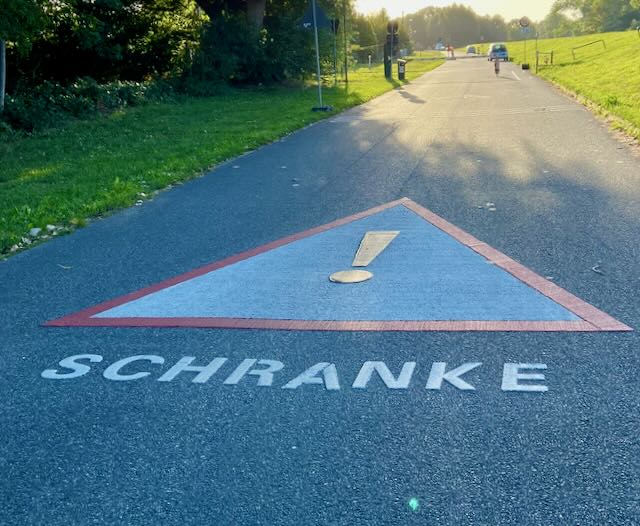
For the road markings, take Kaltehofe as an example. There are barriers there in front of the old waterworks, intended to stop vehicles without the appropriate permission from driving through. A good distance beforehand there’s a marking reading “Achtung Schranke” — barrier ahead. Painted onto the road. A little further on there are three transverse stripes that are easy to register from a bike, and then immediately after that a triangle. You can see it in this picture.
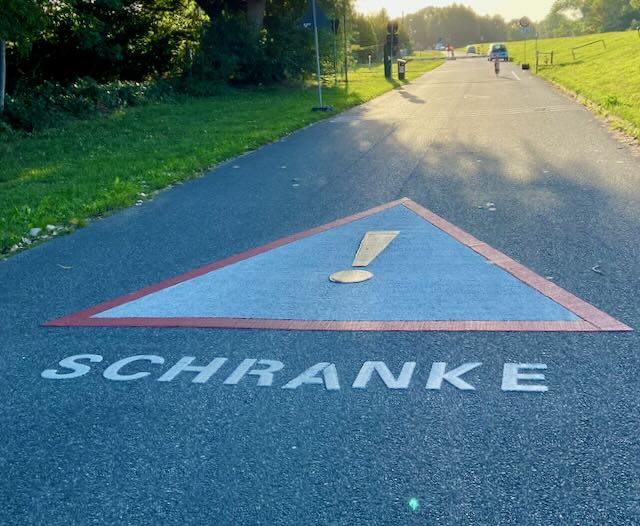
I’m quite sure that lettering exists because a few road cyclists wrapped themselves around those barriers. I could imagine something similar in large red letters ahead of the parking zones: “Warning! Parked cars!”
And on the other side of the equation: these days I ride around lit up like a Christmas tree. A flashing light on the helmet, a flashing light on the jersey; I even have a rear light that uses radar to look 100 to 150 metres behind me for drivers approaching who haven’t seen me, and then switches to its brightest setting. You have no idea how often, over thousands of kilometres on the bike, that has sent me to the edge of the road. I’ve accepted that in an inattentive world, moving about more or less unprotected can occasionally get dangerous. Even if that inattention is something I can get very annoyed about.
-
The fact that I’m not keen on right-wing populist nonsense, it appears to have forgotten. … ↩
-
Oooooookay, strictly speaking it’s a continuous succession of roads all named along the lines of “something-or-other Hauptdeich”. But it rides like a single road. So I’ll stick with “the road”. ↩
-
Although the island of Fehmarn still appeals to me considerably more. And the cycling there is wonderful too. ↩
-
For the source, see the first press release linked later in the text. ↩
-
Although I find the argument in the article — that parked cars contribute to road safety because they slow traffic down — a little far-fetched. ↩
-
As an East Frisian in exile, I’m used to rather different pinch points in Amdorf. ↩
-
Hamburg’s city boundaries are a story full of oddities anyway. But that doesn’t belong here. ↩
-
The area has the walking-with-Henry seal of approval … ↩
-
Last year I got to know an acquaintance who actually lives in the Vierlande. While we were talking, a helicopter came in to land. Her resigned comment was “that happens quite a lot here”, and we walked on along the dyke. ↩
-
This is where the police’s call to keep your attention permanently more than 10 metres ahead — as expressed in the “Kopf hoch” campaign — goes slightly past the realities of riding, because keeping a close eye on the road surface is fairly essential. ↩
-
Oh yes, won’t somebody think of the children! But heaven forbid a 30 km/h zone or even a home zone gets introduced anywhere. ↩
-
MAMIL = Middle Aged Man in Lycra. There’s no established term for the female version. But since I’m quite certain the same phenomenon exists among women, I’ll simply use MAWIL for it. ↩
-
Yes, I rode around like that myself during my extreme cycling years …. ↩
-
Forgive me a cynical aside here: someone reaching for Jan Ullrich as a comparison today places their own age and their engagement with the sport just as precisely as my mother’s use of the word “Nintendo” for anything that remotely resembles a games console. (The generation after her knew the difference perfectly well.) ↩
-
Low German, roughly: “and now what?” ↩
-
The paragraph that forbids me from marching in step across bridges as part of a closed group. ↩
-
Goodness, how often I’ve wished for instant karma in the form of an unmarked police car at moments like that. Foul-mouthed abuse is where my patience does run out. ↩
-
The bikes are extremely good, but to me they come across as SUVs in bicycle form. ↩
-
Although the poor infant can’t help it when he’s pushed into a critical situation; he is, so to speak, a traffic idiot by proxy. ↩
-
Okay, downhill riders seem to accept it somehow. But then, they’re a different breed. It’s YOLO on two wheels. ↩
-
German idiom: to have tomatoes on your eyes is to be oblivious to something right in front of you. ↩
-
Braking hard without falling off is a skill in its own right. ↩
-
Low German: “it’s all already there!” ↩
-
And while we’re at it … shouldn’t we then also look at the fact that sailing boats need no licence? I can reach very high speeds on one of those too, yet often don’t need the German recreational skipper’s licence for it. The probability of something going wrong is presumably lower, but when it does, the damage is large. Why can I only ride an unrestricted motorbike after several years, while a heavily powered 500 hp motorboat is no problem at all the day after passing the test? None of this is free of contradictions. But that’s taking us too far afield. ↩