
(Ein wichtiger Hinweis: Ich bin medizinischer Laie. Ich habe nur lange mit meiner Krankheit gelebt. Ich kann alles medizinische hier falsch verstanden oder falsch wiedergegeben haben. Jede in diesem Text wiedergegebene Information ist potentiell aus dem Zusammenhang gerissen, falsch, unvollständig. Hört auf Euren Arzt! Fehler sind meine Fehler, nicht die meiner Ärzte.Meine Erfahrungen sind anekdotisch. Eure Erfahrungen können anders sein.)
So I’d left the Albertinen hospital. Was at home. How did things go on now?
Follow-up rehabilitation treatment
It’s a very unwieldy word: Anschlussheilbehandlung [follow-up rehabilitation treatment]. A typically German monster of a word in its own way. That stringing-together of words that I now make jokes about in talks before international audiences. Because some word-monster or other almost always crops up in my talks. But I usually also explain that the long German words are a composition of shorter words. We don’t actually have more letters per word, but really just fewer spaces per sentence. In any case, may I be forgiven for simply writing AHB in the following instead of Anschlussheilbehandlung. I have the impression that writing out this word alone would double this text in length.
A few days after my hospital discharge the time had come. I went into a hospital again. Yay. Yet again. As if I hadn’t already had enough hospital days on my punch card this year. Corona was behind me. The test strip was snow-white again. But why into a hospital yet again? The inpatient AHB basically takes place in a specialised hospital. It’s also possible outside hospitals, but I’d decided against that.
After you’ve left the acute hospital, you’re far from healthy. Or even fit. Therefore the AHB is urgently recommended not only after an aneurysm operation. After the acute hospital I was really done in and needed recovery. I had to, as it’s so nicely put around here, “get back on my feet.” Build up strength. Recover from the constant lying down. The AHB is there to continue what the acute hospital started. The AHB is supposed to reintegrate you into working life. That’s also why it’s not paid for by the health insurance, but by the pension insurance. Convalescence is far from complete even after the AHB. But you are a very clear step further along.
A few days before the journey into the AHB I finally became corona-negative. I’d already thought I might not be able to start the AHB. Although, to give truth its due, I wouldn’t have been entirely unhappy had the AHB been postponed once more. After the longer lying-time in hospital with isolation, I asked myself whether I wanted to go straight back into hospital for three weeks. Whether I wanted to start sport again so shortly after a survived corona infection. Because to a large extent the AHB is sport, on a low level perhaps, but physical activity all the same. I’d been made a little unsure by comments in the Fediverse that you should rather keep the ball low in the first four weeks after corona. Besides, after the ten days of isolation I first wanted to recharge my social battery with people around whom you can simply be yourself, because they’ve known you for decades. Family, that is.
On the other hand, in the days I was at home, I noticed very much that I was far from being in a good physical condition again. I was tired, I was drained. It means a lot if I largely spurn a slice of cake. In the end, therefore, shortly before departure I was glad that I became negative and could go into the AHB. Waiting would only have created more problems anyway. You have to begin the AHB within two weeks of the hospital stay at the latest, unless good and substantial reasons stand against it. Frankly, I didn’t much fancy the discussion. So reason won, and I drove into the AHB.
Bad Bevensen
The inpatient follow-up rehabilitation treatment is offered in clinics specialised for it. For me it was the rehab clinic of the Heart and Vascular Centre in Bad Bevensen. It was off to one of probably the most boring places in the world that I know: Bad Bevensen.
It’s perhaps not the backside of the world. The railway line from Hamburg to Hannover prevents that. But you can see it clearly from Bad Bevensen. Very clearly.
Although … that’s basically possible from Lüneburg too. Everything behind the Elbe Lateral Canal becomes really lovely. I like cycling there. But it’s all just a bit out of the way. The Elbe, with its few fixed crossings, is probably responsible for it being quite quiet here. Then there’s also the separation by the Elbe Lateral Canal, which was actually intended as a barrier during the Cold War. This structure has somehow kept its nature as a barrier, even though the Cold War found its provisional end. For me, a very quiet area begins behind the Elbe Lateral Canal. Former zonal border region, that is. But it produces something that’s essential for recovery: quiet.
By the way: I can imagine why Gorleben was chosen back then as a nuclear-waste final repository. Who could have reckoned that, of all places in this corner of Germany (and at the time of the decision it was even more of a corner there, due to the still-existing GDR), so much resistance would develop? Or perhaps that’s precisely why it should have been reckoned with. I don’t think the people who live here let much slide.
Back to Bad Bevensen: I know that’s a very personal assessment. I also have nothing against the place. There’s a very good reason for that: my big little sister. But I find the place only a little interesting. If, however, you live in Lüneburg and miss the bustle of Hamburg, then Bad Bevensen is perhaps not the right direction to move in. Probably many other people find the place wonderful for their purposes and needs. I’ve already heard of several people who moved to Bad Bevensen because they wanted to be near the HVC, because their heart or their vessels were extremely afflicted and required constant competent treatment.
If you come from Lüneburg, the main advantage of Bad Bevensen, in my view, lies in the fact that you can shop there on Sundays, thanks to the spa-town regulation. So if you’ve completely forgotten that Saturday evening has already come and the fridge is empty, you can help yourself with a drive to Bad Bevensen. Again, a very personal assessment about the indisputable added value of this place.
For me, really only a few things spoke in favour of this place, but these were very weighty and ultimately decisive. The Heart and Vascular Centre here enjoys a very good reputation. Behind that lay the idea: if something goes wrong in the rehab, an acute clinic is right here on site that knows what it’s doing with cardiac surgery. A matter of mind. And I had a support system on site: my sister lives here with her family.
If I understood the building correctly, the HVC is structured so that, with a heart operation, you’re passed through from back to front. At the back (seen from the street), in a new building, is presumably the heart and vascular surgery with intensive care unit, in the middle the acute hospital and right at the front the rehabilitation clinic. So I felt in the best of hands.
Of course I’d rather have gone to the Baltic Sea for the AHB. Simply because it would have been lovelier than the clinic at the edge of the b… er … at the edge of the world’s posterior. And I just love the sea. But many things would then have been more complicated. Visits. Provisioning (I hadn’t brought enough clothing and didn’t want to use the communal washing machine. Why would I, when my own wardrobe was a stone’s throw and 20 km away). So it was rather practical considerations that carried me there when I decided on Bad Bevensen.
Equally charming about Bad Bevensen was also that it’s barely 30 minutes by car to get from Lüneburg to this place. But also just 30 minutes to get away from there again. By train it’s a bit more, but between Bevensen and Lüneburg there’s more or less just the Bienenbüttel station. You first have to get to the station, though, and then away from it again in the other place. But quickly to Lüneburg and back again would be no problem by train. Which also led to my often hearing at mealtimes that people would go into the town of Lüneburg at the weekend. With an enthusiasm at which I asked myself: “Okay, I like Lüneburg, but it’s not aaaaall that great either.”
For me the proximity was of significance towards the end of the AHB. When the AHB is over, you’re also first of all out of the close monitoring by doctors, back to the normal GP coverage. Towards the end I wanted to know how my head would cope, at the end of the AHB, with sleeping at home again. So for the last two days I drove home each evening, to stand at the door again in Bad Bevensen in the morning. In the end I also spared myself the meals. And it worked out well.
Three weeks at the edge of town
How do you have to imagine such an AHB? There are outpatient AHBs and there are inpatient AHBs. I’d decided on an inpatient AHB. After admission and entrance examination, I was first of all assigned my accommodation. Third floor. I was really grateful for the lift. The building has come a bit on in years, but the rooms were functional and very clean. At some point someone from the therapy department came to my room. First a six-minute walk test. They want to know how resilient the newcomer is. A programme is put together. At this point I’d asked not to have to take part in any water sport. I’d just rather be on the water or by the water than in the water. The wish was granted me.
And then you get a plan up to the end of the week of what you have to take part in. Trainings, sport, examinations, treatments. All nicely written down in a kind of timetable. Unfortunately you also have not-insignificant free periods. I actually got through the third volume of the Three-Body trilogy in the AHB. But I think the free space is also part of the programme. And then anew every week. I hauled myself through the time by these “timetables.”
In the morning at just after seven “Meditative movement.” I can’t prove it, but I’m fairly sure that this event wasn’t about moving meditatively at just after seven. From my point of view, the only really significant movement of this event already took place well before the 15 minutes of the event. Namely the moving of the backside. Out of bed, under the shower. Morning exercise, during which I kept having the Gebrüder Blattschuss song in my head: “And tomorrow we’ll explain to you how to undo this knot again.”
Before the sport, first take vital parameters. You did that yourself in the AHB. At some point I dispensed with joining the queue for the blood pressure devices and instead brought my own blood pressure monitor along. Write down. Take temperature. Write down. Weigh. Write down. Have breakfast. If you were unlucky, blood draw. Treatments. Sport. Trainings. Lunch. Treatments. Sport. Trainings. Dinner. After dinner there were cultural events. My personal cultural events consisted more or less of watching Netflix, reading books and hanging around in my room. Visiting family.
That I wasn’t quite the target group for the official evening events became clear to me at the latest when, one evening, I went unsuspectingly to dinner. A young woman was singing in the foyer. “Amsterdam.” For those to whom that means nothing: it’s from the year 1984. By a group that calls itself Cora. Music that was often heard on the hit parade. When I came back from dinner, the same lady was singing “Backe backe Kuchen” [a German nursery rhyme]. I’m very sure that one of the people present played a very nasty trick on the young woman with a request. I can’t explain the music selection any other way.
I honestly hauled myself from meal to meal. But with that I simultaneously also had a bigger problem that arose from my long isolation. It was about dealing with the closeness.
Closeness
You have to know that there’s a patient restaurant in Bad Bevensen. You don’t get the food in your room. Instead you go – if you don’t demonstrably have a contagious illness – to eat in a large patient restaurant. That’s part of their treatment philosophy. Many people sit quite close together in this restaurant.
They’re apparently aware of the challenges that come with seating so many people so close to each other. Here there were still the Plexiglas partitions between the seats that came into fashion during corona. You have to imagine it as a kind of plus sign that divides a nearly square table into four segments. Why two tables were then placed next to each other so that, for example, the lower-right segment of table A sat directly, without partition, next to the lower-left segment of table B, I have no idea. They could have spared themselves these partitions too.
Mask
In the rehab I wore a mask practically constantly. Whenever I was in an enclosed space … mask on. It was unlikely, admittedly, that I’d get corona again straight away, but I also didn’t yet have a flu vaccination at that point. And I didn’t fancy getting flu. For many reasons. Mainly, though: no desire for isolation.
I even ate with a mask. Pull the mask down briefly. Eat a few bites. You shouldn’t be breathing then anyway. Otherwise it’s called choking. Pull the mask back up. That even worked quite well. I just had very good reasons to assume that without a mask I’d catch something.
I got quite a few strange looks for it during the rehab. But when you hear so many people around you coughing productively, hear the sound of noses being sniffed up at you, you become careful. Yes, I know, that’s life. You only have to go on public transport or into an ordinary supermarket to hear the same.
And yes, perhaps I’m super-careful there. During that time I also wore a mask at my relatives’ place, so as not to drag anything in from the hospital. I have several very good reasons for that, foremost that my parents are, after all, getting a touch older too.
After I’d caught corona in the acute clinic, I didn’t want to add anything else on top here. I didn’t want to catch anything that would throw me into isolation again for several days. And I didn’t want to lie in bed with some infection, perhaps even break off the AHB because of it. I simply couldn’t have endured that mentally. I wanted to sit out my three weeks in the AHB and then concentrate on my mental convalescence at home.
I’d probably have just run naked through the hospital corridor at some point, yelling “Catch me!” With nurses trying to catch me in tow. And then I’d probably have ended up in a third hospital in Lüneburg. With those nice people who bring along a jacket that’s closed at the back. Or, as a person still close to me calls it: the love-me jacket.
Risk assessment
I noticed again, in the process, how bad people actually are at assessing a risk and, even worse, at locating the risk correctly.
In any case: diagonally opposite me sat a patient who paid very close attention to the partitions between the seats opposite me being completely closed. For him I was one of the riders of the apocalypse. As if I’d opted for the fourth horse as an assistance animal.
At the same time you then heard, in many places, precisely the aforementioned nose-blowing, the coughing that sounded so suspiciously as if the entire lung would come out with it, the sniffing-up of the nose. All the signs of a really healthy respiratory tract.
But in the eyes of my fellow patients I was the problem. Because I wore a mask. So I must have something. The one from whom the lowest risk probably emanated. And that showed me again how bad people actually are at assessing risks. That’s the reason why it will never again be possible to lead society, at some point, into a joint fight against a new pandemic. Whoever can’t assess risks correctly can’t act against them either.
Change
It’s quite strange. The HVC seems to be constantly admitting and discharging people. Most stay three weeks. And then leave again. That means there’s constant change around you. Faces you’ve seen for a few days disappear, while you yourself still have a few days ahead of you. Meanwhile you see new faces that are still there while you yourself are already back home. Somehow everything gets lost in this change, though.
I honestly can’t really remember the people any more. I remember a band hoodie of a seat neighbour in the patient restaurant, which I correctly assessed as merchandise of a far-right band. I was a little shocked at how openly he wore it. He also only wore the hoodie once. So I can’t have been the only one to notice it.
I remember a patient, but there too only the bright-red sports shoes. “Red Sports Shoes” was educated. The few words you exchanged permitted the conclusion. This person was the first to ask why I was wearing the mask. I remember the sports shoes.
Or the patient with the cutest assistance dog that has crossed my path so far. Whoever considers their dog well-behaved would have found a dog there from whom many dogs could have taken a leaf. I remember the dog fondly.
Or the patient who knew many interesting stories to tell from his professional practice, but whom it had hit really nastily. I remember the event on the subject of stress management. Even though the people had the most varied backgrounds and different illnesses led them to the HVC, the fundamental problems with regard to stress seemed to me similar and so familiar.
In the end I asked myself (and I voiced this conjecture at the end of the last event of the stress series) whether the stress had, as it were, hit us and we became ill from it, or whether we have the stress because we are the way we are. And the illnesses are therefore a consequence of how we are.
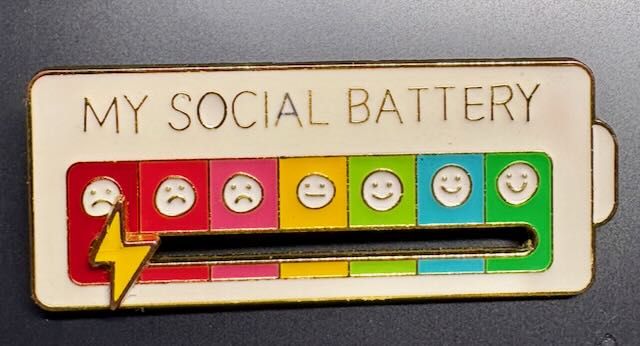
But the people? That all somewhat passed me by. I took care of my convalescence, and that was it. I didn’t go there, after all, to get to know people, but to get well. The people weren’t really important to me in that moment. I was too focused on my illness. But that may also be connected with the fact that, during this AHB, my social battery for making contact with new people was simply empty due to the events of the year. I find it hard even with a halfway charged battery. During that time it was out of the question.
In the AHB, with my illness and my operation, I was a little in the minority. I recognised that with the question in the gymnastics of who had a chest incision. That’s the sternotomy, the opening of the chest, that I already wrote about. Some gymnastic exercises simply strain the breastbone too much, so that you were only allowed to do the exercises to a limited extent or not at all. But quite few people raised their hands each time.
By far the most people seemed to me to be in the AHB after heart attacks and similar events. Some people seemed to me so young and sporty that I asked myself how this person had come by their problem. I asked myself why these people were in the AHB. I can only urge every reader here to take care of themselves and their heart. Too quickly you’re a patient in Bad Bevensen or comparable institutions.
I have the impression that that’s an increasing problem. During my stay in Bad Bevensen the rescue helicopter was a regular guest at the hospital. That told me, on the one hand, that I’d made the right choice with the rehab hospital, since emergencies were obviously transported here. My idea of choosing the HVC because of the attached acute hospital wasn’t so daft after all. In case of problems I’d probably have been flown there anyway. The frequency with which the rescue helicopter appeared nevertheless frightened me a little.
In conclusion you can at most ask yourself why I planned so much on the negative side. And that’s a very legitimate question. Why I went to Bevensen.
Balance
What else do you do in the follow-up rehabilitation treatment? Primarily move your backside. Among other things I did gymnastics – the first time since my school days – and only noticed here how bad my sense of balance had actually become over the years, for a child from the countryside.
I mean, as a child, when climbing trees, I depended on my balance working more or less. And as a child I climbed a lot of trees. Or when balancing over trees that protruded across streams. I can also still do a forward roll and a backward roll. My white-haired sports teacher from primary-school days saw to that. But at least of the country-child balance there’s hardly anything left. Although I have to admit that I came home wet more than once in my childhood, because the balancing didn’t work out so well. Or with scratches, because I got cocky.
I had breathing-relaxation training. But with the switching-off of the light, my thought-machine switched into the mode “now we can catch up on all the thoughts once more, to work through what happened the last weeks.” Quiet, for me, is somehow like pouring petrol onto the mental fire. The breathing didn’t help much there either to bring some calm into my skull. But at least during this time I didn’t have to balance on any objects. And that was quite great.
What did me good was the fast walking during some exercises. I’d always said that I’d most like to tie the poles of some Nordic-walking groups around their necks. But I have to step back from that now. More than once I walked, within the framework of exercises planned for me, with precisely such poles in the group around the rehab hospital. That moved me forward after the operation. You really need it after the operation. Doesn’t sound like much. But in the first week after discharge you don’t really want much more either. By the end of the AHB I was even running again. Not much. With interruptions. But I noticed by it: this really does do something.
What was the most fun was the ergometer training in the AHB. Daily ergometer training. But only 100 watts. More wasn’t granted me. That was okay too, only on the Borg scale I didn’t get beyond 7 to 8 with it. The Borg scale is quite interesting: instead of simply taking some measured values, this scale asks how you feel with the strain. Is it very strenuous? Is it rather very easy? So the scale answers the question of what the strain does to you. 7 to 8 already indicated rather low strain.
But all of that showed me that I didn’t have to spare myself completely with the operation. That the sutures in my body wouldn’t fly apart just because I exhaust myself.
Blood
In my time in the acute hospital and in the AHB, I had to give something relatively often: blood. I have no problem with that. I was a blood donor until the German Red Cross wrote to me that, due to the aneurysm, they’d refrain from having me as a donor. I don’t quite know what the problem was, but the German Red Cross decided that way. To go anyway wasn’t an option, though. They’d have seen that I was blocked, I’d also have had to tick that the blood donation had already been refused me once. And they’d have sent me home again without a possibility to donate.
When someone is really good at taking blood, I actually don’t even really notice that someone’s after my blood there. These people say briefly “It’ll get cold now” (do you have to attend a training that you don’t pass without this sentence? I really always hear this sentence …), and then the blood is actually almost already flowing.
The actual problem arises when someone can’t do it. And that’s unfortunately not just a marginal phenomenon in the medical world.
Taking blood is apparently something that you can either do or can’t do. There somehow doesn’t seem to be an in-between. Either you have a nurse who pokes around in you, doesn’t manage it and at some point moves on to the mean spots, because it’s apparently easier there. It then usually turns out, for me, that it’s not easier. It just hurts more. I’ve already sat with gritted teeth during a blood draw because someone wanted to take the blood from the back of my hand. The whole thing produces very interesting bruises. Especially with blood thinning. For example, in my case once a feels-like-area-wide green-yellow back of the hand.
Or you have someone who sets the needle, pricks, hits and completes the blood draw in no time at all. No big deal.
There’s no bell curve here. No large group of people who manage it quite well. But only extreme values. Okay, experts of blood-taking may recognise a bell curve there too. I’m unable to.
That may perhaps also be connected with the fact that I divide people into “one prick, one hit” and “pincushion.” But it’s also been the case so far that I’ve never encountered anyone at blood draws who maybe needed two attempts. No. It was always the extreme values.
The whole thing wasn’t so much a problem in the acute hospital. There I had an access line from which they also took the blood for the samples. In the follow-up rehabilitation treatment it was a challenge. Most of the staff I had contact with for blood draws there were very good at it. But just some weren’t either.
I have thick skin. I know that I don’t make it easy for people with the blood draw because of it. But some of the blood draws stuck very negatively in my consciousness. Although I only said late that it was enough now and that someone else should perhaps try to take the blood. You don’t want to make a fuss, after all. But when, on the fourth attempt (by now on the back of the hand, with clear gritting of teeth), no decent blood flow comes about, you have, I believe, every right to ask for someone who stands on the other extreme-value side. With a certain pleading in your gaze. And with several plasters on the way out of the room for the blood draw.
Physical finding-of-one’s-feet
Physically things went uphill quickly in the AHB. I quickly felt not really fully worked. I’d hoped that in the rehab I’d be brought to my current limits. From this limit I’d then have subtracted ten or 25 per cent, and that would have been my physical limit for the next while. But it doesn’t work that way. The rehab and everything that follows approaches this limit from below and shifts this limit ever further upward.
I used to tread 250 to 300 watts over 20 minutes. This summer it was still a respectable 220 to 250 watts. This fitness is no longer there. Far from it. I’ll have to work on that further.
Besides, you have a limiter in your head. During the stress ECG I could have managed considerably more than 175 watts over two minutes. My legs remember the lot of cycling, which makes treading high wattages quite easy for me. 175 watts is, according to the doctor, already very much. It’s okay. Normally people go home with typically 100 watts.
But I also noticed: I didn’t dare tread more. I considered: I have sutures in my body there. Where the prosthesis was connected to the remaining aorta. How much do they actually hold? And then all the considerations on the subject of blood pressure. Just because you’ve had that operated on doesn’t mean by a long shot that you’ve lost this mindset. How much may you actually do now exactly? Dozens of thoughts that then at some point mean a mental limitation.
In my final doctor’s report it states, for the stress ECG, dyspnoea as the reason for stopping. But that’s not quite right. It was funk. And I don’t have to prove anything to anyone, after all. It was, anyway, of no consequence for me where I’d come out there. So I followed my head, which told me: “Better stop now.” And you probably can’t write it that way in a doctor’s report: “Patient Moellenkamp ended the stress ECG at 175 watts due to funk.” Although: funk is associated with dyspnoea. Perhaps it fits after all.
Mental coping
Physically things went astonishingly well after the AHB. But I’d underestimated how much my head would still occupy me afterwards. That’s what tomorrow’s fifteenth chapter is to be about.
