
There is a really interesting tool to gather information from a running process. Let’s assume a fellow admin is in her or his well-deserved vacation after a gruelling release and now you have to reboot the new machine, because you have to service the memory. Of course you look into the documentation and you find a process that isn’t covered by the documentation and there doesn’t seem to be a startup script or SMF manifest that starts this application. D’oh — yet another last-minute pre-vacation change — shouldn’t happen, but it does happen from time to time. I used it as one of the tools in my tool belt to find out if really everything has been persisted into startup files and documentation.1
Let’s assume you found a process called application.py in the process list:
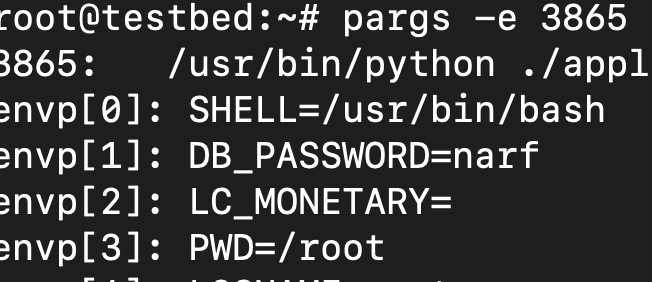
root@testbed:~# pargs -e 3865
3865:   /usr/bin/python ./application.py --db=testdb --username=test
envp[0]: SHELL=/usr/bin/bash
envp[1]: DB_PASSWORD=narf
envp[2]: LC_MONETARY=
(...)
envp[17]: MAIL=/var/mail/root
envp[18]: LC_NUMERIC=
envp[19]: _=/usr/bin/nohup
There is another interesting switch. You can use pargs with the -l switch to get the full command line that was used to start the script.
root@testbed:~# pargs -l 3865
/usr/bin/python ./application.py '--db=testdb' '--username=test'
-
Okay, the last test is simply rebooting the system at the end and looking if everything still works, but I like this test reboot as drama-free as possible. ↩